
Top Signs You Need Garage Door Service – Don’t Ignore These
The most expensive garage door repair is the one that happens because you got used to the problem. A door that takes two button presses to close, a grinding noise you’ve heard for three months, a gap at the bottom that wasn’t there in October – these aren’t quirks. They’re a bill that’s growing. The signs of a failing door almost never look like emergencies at first. They look like minor annoyances you adjust to, until the door doesn’t move on the morning you need to leave for work. This guide covers the early-warning signals we see most often in South Ozone Park, and what each one actually tells you about the parts inside your door system.
Key Takeaways
- Popping, grinding, scraping and rhythmic thumping are not “normal garage door sounds” – each points to a specific component wearing out.
- Rust streaks, tight coils of wire on a spring, and fraying on a cable mean failure is a matter of time, not possibility.
- A slow door is never just slow; the three mechanical causes behind speed loss all get worse the longer you wait.
- A door that hangs unevenly or sags on one side may be structurally compromised, not just out of adjustment.
- Drafts, visible light gaps and shrinking remote range are early signals of a failing seal or a declining opener.
What Sounds Are Normal – and Which Ones Mean Trouble?
A healthy garage door makes a low, steady hum from the opener and a soft roll as the panels move. That’s it. If you can hear your door from inside the house with the door closed between you, something is grinding toward a repair. The specific noises matter, because each one points to a different part.
- Popping or a loud bang that comes from above the door usually points to a torsion spring under load. Popping is not a sound to live with – it can mean a spring is winding down toward a break. Stop using the door and have it looked at.
- Grinding tends to come from the opener’s gear and rail assembly, or from rollers that have flattened and stopped rolling. Left alone, grinding wears the opener’s drive gear until the door stops moving entirely.
- Scraping is metal on metal – often a bent track or a panel that has shifted and is dragging against the frame. Scraping is a fit problem, and it gets worse every cycle.
- Rhythmic thumping that repeats with each turn of the door usually means a worn or unbalanced roller or a loose hinge. It starts as a nuisance and ends as a door that binds.
Here’s the honest test: if a new sound showed up and it’s still there three months later, it didn’t heal itself. We work on Craftsman, LiftMaster, Chamberlain and Raynor systems often enough to know that most of these noises come from parts that are cheap to address early and expensive to ignore. If you’re not sure which sound you’re hearing, call (877) 810-4860 – a quick description over the phone usually tells us what’s going on. We answer 24/7.
What Do Rust, Fraying and Spring Gaps Actually Tell You?
Springs and cables do most of the heavy lifting on your door, and they fail in visible ways before they snap. Look at them – from the ground, never up close with your hands. Rust streaks on a torsion spring mean the steel is thinning, and a thinning spring loses tension until it breaks. A cable with broken strands poking out like a frayed rope is holding less load than it was designed for. And a torsion spring with a visible gap between its coils is no longer wound correctly.
What rust, fraying and spring gaps all mean in practical terms: the part is past its service life, and failure is coming. The timeline varies – a rusting spring can let go in weeks or hold on for months – but none of these signs reverse on their own. The reason this matters is safety. Garage door springs are under very high tension, and a spring or cable that lets go can injure anyone standing nearby. This is not a repair to attempt yourself. Even experienced tradespeople treat spring work as its own discipline, and that’s why we cover garage door repair with spring work treated as a dedicated service rather than a side job.
South Ozone Park winters bring freeze-and-thaw cycles that are hard on door hardware, and the salt and grit tracked in from the street settle on springs and cables over time. If you haven’t looked at yours since the fall, take a minute this week. Call (877) 810-4860 if anything looks off – estimates are free, and we’ll tell you straight whether it’s time to replace the part or just keep an eye on it.
Why Is a Slow Garage Door Never “Just Slow”?
Speed loss in a garage door comes from three mechanical causes, and all three get worse faster than most homeowners expect. The door doesn’t gradually slow down for no reason – it’s fighting something.
- A weakening spring. The spring does the lifting; the opener just steers. As the spring loses tension, the opener works harder to raise the door. That strain shows up as a slower door – and as heat and wear inside the motor.
- Dry or worn moving parts. Rollers, hinges and tracks need to move freely. When rollers flatten or dry out, friction increases, and the door drags. Sitting on friction for a year shortens the life of every part in the chain.
- An opener that’s losing torque. Motors and drive gears wear too. A fading opener on a LiftMaster or Chamberlain system often shows its age as sluggish movement before it fails outright.
The reason we push homeowners not to shrug off a slow door: each of these causes feeds the next. A weak spring makes the opener work harder, which wears the motor, which makes the door slower still. A door that takes noticeably longer to close than it did last year is not the door settling in – it’s telling you to get it looked at. If you’d rather not guess which cause is behind your slowdown, call (877) 810-4860 and we’ll take a look. Fast dispatch from 7am to 7pm, Sunday through Friday.
How Do You Tell a Sagging Door From One That Just Needs Adjustment?
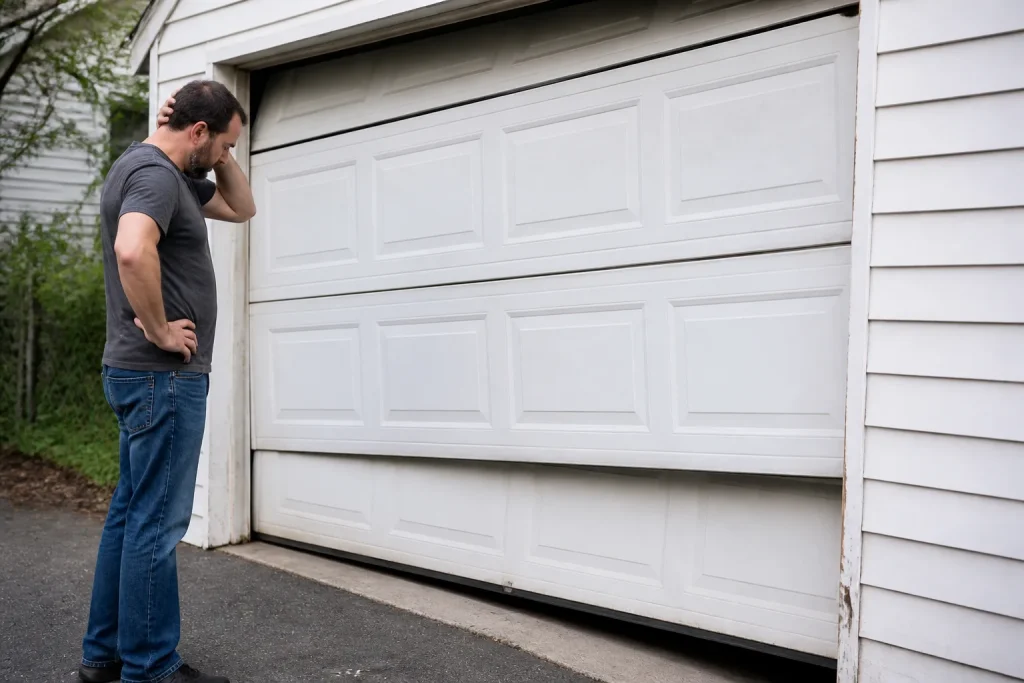
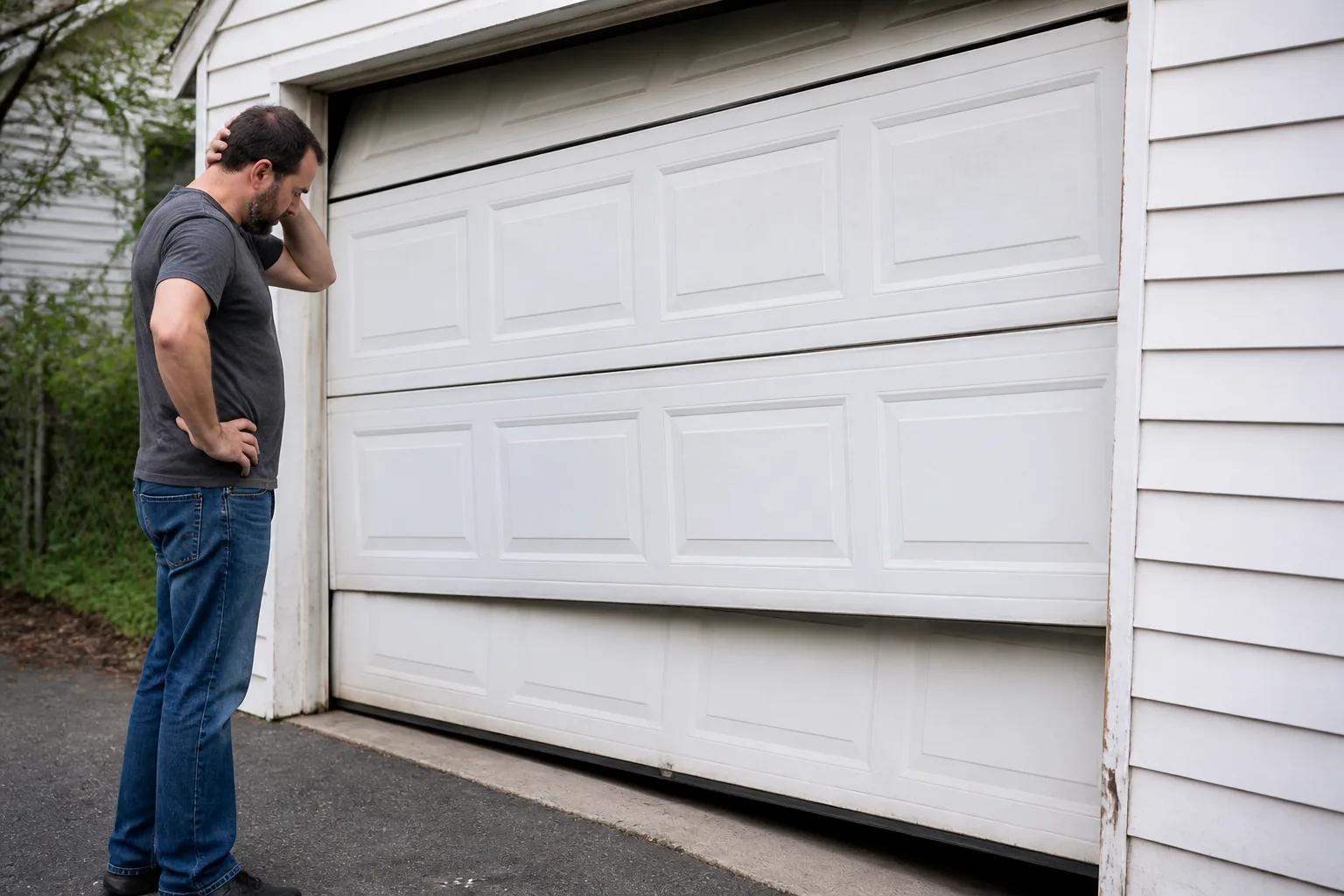
The sagging test is simple and safe to do from the ground. Open the door partway and look at the gap between the bottom panel and the floor from left to right. Then stand back and look at the door’s top edge – it should run parallel to the header. If one side hangs lower than the other, or the panel line slants when the door is halfway up, you’re looking at a fit problem worth diagnosing.
Not every sag is structural. Sometimes a track has shifted slightly or a hinge is loose, and a straightforward adjustment puts everything back in line. But a door that sags on one side, or binds when it moves, often points to a broken or weakening spring on that side, a bent track, or a panel that has warped. A warped panel can’t be adjusted back into shape – it has to be replaced. That’s where a genuine full-spectrum specialist earns their keep: if the repair reveals the door is past saving, you don’t have to find a second contractor to handle garage door installation. From opener to panel, one call covers it.
One practical note for South Ozone Park homeowners: older doors on homes that have settled through many winters sag more often than newer ones. If your door has a visible slope you’ve been meaning to look into, don’t wait for it to jam. Call (877) 810-4860 for a free estimate.
What Do Drafts, Light Gaps and a Shrinking Remote Tell You?
These three signals are the ones most checklists skip, and they matter for two reasons: your energy bill and your home’s security. The door is the biggest opening in most houses, and every sign here points to the same thing – the system is drifting out of alignment.
- Drafts and cold air at the bottom of the door. A draft means the bottom seal has worn flat or pulled loose. Beyond comfort, a bad seal lets in winter air, grit and pests.
- Light gaps along the sides or bottom. Shine a light outside at night and look from inside, or look from the driveway during the day. Visible light means the door isn’t seated properly – the seal, the track or the door itself has shifted.
- Shrinking remote range. If you used to open the door from the end of the block and now you’re pressing from the driveway, the opener is likely on its way out. Fading range on a Genie, LiftMaster or Chamberlain opener is a sign its receiver or board is degrading, or the safety sensors are drifting. We handle garage door opener repair for both legacy and modern smart systems, so you’re not stuck waiting on a manufacturer’s service queue.
Individually, any one of these could be fixed with a seal or sensor adjustment. Together, they suggest the whole system is strained. Either way, these are South Ozone Park problems worth catching early – a new bottom seal is a small job, a door that won’t seal can become a door that sticks.
When Should You Call a Pro Instead of Watching and Waiting?
Some checks are things you can do yourself: look at the springs from the ground, listen for new sounds, test the seal with a flashlight, notice when the remote needs a longer press. What you shouldn’t do is touch a spring, cable or opener under load. Those are the parts with real injury risk, and they’re the parts where an experienced eye saves you money. Our technicians have up to 12 years of experience, and we work on your brand – whether that’s a Craftsman door from decades back or a modern LiftMaster with a smart opener. If you’ve walked through the signs above and any of them apply, don’t talk yourself out of the call. The cost of waiting is usually the bigger bill.
The Bottom Line
The signs that your garage door is heading for a serious repair show up early, quietly, and in parts you can check in a few minutes. Sound, sight and feel catch almost all of them: a new noise that won’t go away, rust or fraying on the springs and cables, a door that’s slowed down, a visible sags, a draft at the bottom, or a remote that’s lost its reach. Any one of these is worth a look. Two or more means call in a professional before the door stops opening on a morning you need to leave. Spring and cable work is genuinely dangerous, so keep hands off those parts.
If you’re in South Ozone Park and need help, Garage Door Repair South Ozone Park offers free estimates – call (877) 810-4860. We answer 24/7. Fast dispatch from 7am to 7pm, Sunday through Friday. When your door won’t move, neither should your day.
Frequently Asked Questions
Cost depends on the part and the door, and the written estimate sets the final price. Spring repair, opener repair, seal replacement and hardware adjustments all price differently because the parts and labor differ. We quote the work and agree on it with you before anything starts, so you know the number first. Call (877) 810-4860 for an exact quote – estimates are free.
Yes, same-day service is available, and a stuck door is exactly the kind of call we’re set up for. We answer 24/7, and a call outside dispatch hours is booked into the next opening, Sunday through Friday, 7am to 7pm. Call (877) 810-4860 and describe what the door is doing – it usually tells us what to bring.
No – the price we quote and agree on before work starts is the price. If a technician finds something different from what the phone conversation suggested, we explain it and re-quote before touching anything, so there are no surprises on the invoice. Call (877) 810-4860 for a free estimate.
Very likely, yes. Our technicians work on systems made by LiftMaster, Chamberlain, Genie, Clopay, Amarr, Wayne Dalton, Craftsman and Raynor, and the local pro is licensed and insured as their state requires. Tell us the brand and model on the call and we’ll confirm. Call (877) 810-4860 – we answer 24/7.
Written by the team at Garage Door Repair South Ozone Park.
Need Garage Door Help?
Call Garage Door Repair South Ozone Park - the local pro we connect you with is licensed and insured, here with fast help in South Ozone Park.
(877) 810-4860